




















Not every game is built to be conquered. Some are designed to humble you — permanently. If you've ever asked what the hardest card game truly is, the honest answer requires looking beyond luck and into the architecture of decision-making itself. This list breaks down five games where mastery is a moving target, and even the sharpest minds find new layers to unravel.
Poker is the definitive hardest card game for one brutal reason: the opponent is human. Unlike chess or backgammon, there is no static puzzle to solve — the game reshapes itself around whoever is sitting across from you.
Poker GTO (Game Theory Optimal) strategy gave players a mathematically balanced framework for every decision. Solvers calculate optimal bet sizing, bluff frequencies, and range construction with machine precision. But GTO has a ceiling — it assumes a rational opponent. Real players are irrational, emotional, and unpredictable, which means the skill ceiling never closes.
Cognitive hardest card game to learn depth separates elite players from technically competent ones. Detecting timing patterns, reading physical behavior, deciding to fire a third bluff into a calling station — none of that lives inside a solver. A chess grandmaster can calculate variations coldly, but poker punishes cold logic when your opponent plays on emotion. The gap between optimal theory and human reality is where the real game begins.
Shift a bet from 33% pot to 75% pot and the entire response tree changes — new hands become profitable calls, others become folds. Multiply that across six players, four streets, and hundreds of board textures. This is genuinely what is the hardest card game to learn for anyone approaching it seriously, because the decision tree is effectively boundless.
Bridge complexity occupies a category no other card game touches. It layers incomplete information, coded partner communication, and live deduction into a single framework. Warren Buffett and Bill Gates both play it — not because it's relaxing, but because it never stops demanding more.
Partners communicate exclusively through bids — a structured sequence that carries meaning without words. A bid of "2 hearts" can signal an entirely different hand depending on agreed conventions and auction history. Learning this system fluently takes years of dedicated competitive gaming at the table-level.
Elite bridge players reconstruct both opponents' hands by tracking all 52 cards mentally across each deal. Every card played is a data point. The deduction required rivals chess calculation — but unlike chess, the information is hidden and probabilistic. That distinction makes bridge uniquely punishing.
Strategic mastery in bridge means being predictable to your partner, not to your opponents. A technically gifted player who improvises destroys the partnership. Trust and system consistency are as valuable as card-reading skill, and ego is the most expensive strategic leak in the game.
Among the table games available at Shazam Casino, Pai Gow Poker is the one that deceives players most effectively. The pace is unhurried, draws are common — but underneath that calm surface is a logic puzzle that rewards precision and punishes impulse.
Each player splits seven cards into a 5-card high hand and a 2-card low hand. Both must beat the dealer's corresponding hands to win anything. Overload the high hand and the low hand collapses — costing you half the bet automatically. This balancing act is what makes it arguably the hardest card game in the world for players trained in high-variance formats.
|
Scenario 🃏 |
Optimal split ✅ |
Common mistake ❌ |
Result 📊 |
|
Full house + pair |
Full house high, pair low |
Split full house, pair back |
Auto-lose low hand |
|
Two pair (high + low) |
High pair low, low pair + kickers high |
Stack both pairs high |
Weak front hand |
|
Straight + pair |
Straight high, pair low |
Straight high, nothing low |
Lose low automatically |
|
Flush + two pair |
Two pair high, flush kickers low |
Flush high, weak front |
Vulnerable low hand |
💡 Protect your low hand above all else. A weak front hand loses half your bet regardless of how strong your back hand is.
The dealer follows a fixed casino algorithm — mathematically optimized for every possible 7-card combination. You're not exploiting human error. You're navigating a system that never tilts. Understanding the house way and deviating from it strategically separates recreational players from disciplined ones.
Most Pai Gow hands resolve as pushes — one hand wins, the other loses, no money moves. Players from aggressive formats keep reaching for big swings. Pai Gow rewards Go strategy thinking: the goal isn't to capture everything, but to maintain control and avoid catastrophic splits.
Backgammon has been played for over 5,000 years and still hasn't been fully cracked at the human level. A beginner can beat an expert on a good roll — which makes it both maddening and endlessly compelling. Whats the hardest card game is often debated, but backgammon answers the equivalent question for board games without hesitation.
The cube turns a race game into a live financial negotiation. Offering or accepting a double requires calculating your winning probability in real time, reading your opponent's tendencies, and deciding whether the risk-reward tilts toward aggression or retreat. A misjudged double flips a winning game into a devastating loss.
💡 Don't accept a double when your winning chances are below 25%. The math compounds against you faster than intuition suggests.
Each roll produces one of 21 possible outcomes. Expert players internalize that full distribution — knowing which positions each roll creates and how to respond before the dice land. StarCraft micro-management demands fast probabilistic decisions under pressure; backgammon requires the same mental quality inside a pure math framework.
The bear-off phase is where small errors compound rapidly. A single suboptimal move can drop a 70% win probability to a coin flip. Staying sharp and recalculating through the finish is where most recreational players finally crack.
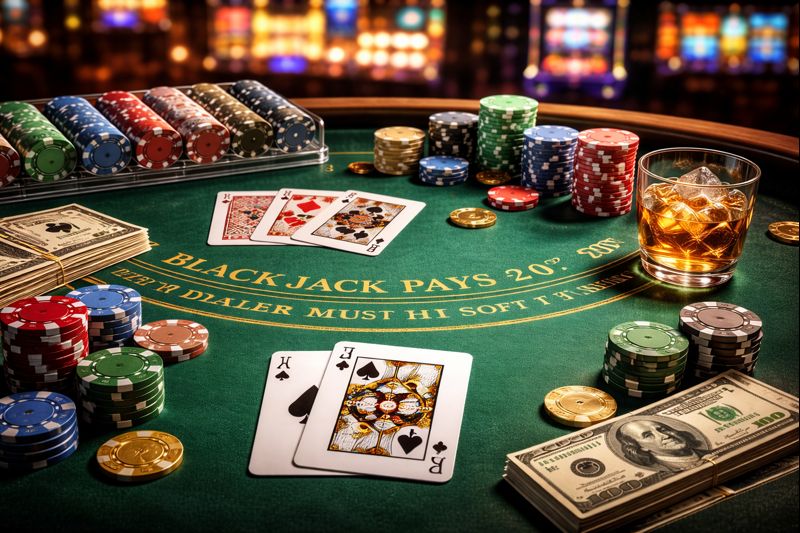
Blackjack's reputation as an easy game is a misconception — specifically, single-deck blackjack with index deviations is among the most technically exacting disciplines in competitive play.
Basic strategy in single-deck blackjack compresses the house edge to roughly 0.5%. One deviation from correct play doesn't feel significant in isolation — but errors accumulate across thousands of hands. Playing at 99.9% accuracy may still produce a losing session. Perfect execution isn't optional; it's the floor.
Advanced play demands maintaining a running count, converting it to a true count, applying the correct index deviation per situation, and sizing bets — all while appearing casual under surveillance. This qualifies as the hardest card game scenario in live casino environments, where four simultaneous mental tasks run with zero margin for error.
At Shazam Casino, extended blackjack sessions are fully accessible — and endurance is where skilled players most often break down. Mental fatigue is the silent edge the house holds over even technically proficient counters. Maintaining counting accuracy across 480 minutes of continuous play is the actual what is the hardest card game final exam.
|
Game 🎮 |
Skill ceiling 📈 |
House edge (perfect play) 💰 |
Core complexity 🧠 |
Time to competence ⏳ |
|
No-limit Hold'em ♠️ |
Unlimited |
Negative (vs. opponents) |
Psychology + GTO |
3–7 years |
|
Contract bridge 🃏 |
Exceptionally high |
None |
Partnership + deduction |
5–10 years |
|
Pai Gow poker 🀄 |
Moderate–high |
~2.5% |
Hand-split logic |
1–3 years |
|
Backgammon 🎲 |
Very high |
None |
Probability + cube |
3–6 years |
|
Single-deck blackjack 🃏 |
High |
~0.1–0.5% |
Count + deviations |
2–4 years |