




















Most blackjack variants keep one of the dealer's cards hidden — that mystery is half the game. Double exposure blackjack flips that script entirely. Both cards land face-up before you make a single decision. It sounds like a dream, but the casino has already accounted for your advantage. If you want to play blackjack double exposure and actually walk away ahead, you need to understand what you're trading in exchange for that transparency.
Seeing the full dealer hand before acting changes everything about how you approach the table. Your decisions aren't guesses anymore — they're calculations. That shift affects pace, psychology, and long-term outcomes in ways most players don't anticipate until they're already down.
When both dealer cards visible lay right in front of you showing a hard 20, you know you need 21 to win or you're drawing dead. That's not intimidating — it's clarifying. Players who used to stand on 17 or 18 "just to be safe" suddenly realize there's nothing safe about it. You hit. You push for the best possible hand because passive play guarantees a loss. Seeing a dealer 20 forces action, and experienced players often say that play double exposure blackjack aggression becomes second nature faster than they expected.
Traditional blackjack psychology is built around hole card information — that one face-down card that could be anything. You build your strategy around probability and fear. In this format, that mental weight disappears. There's no "what if the dealer has a 10 underneath." You know exactly what's underneath because nothing is underneath. Some players find this liberating. Others find it unsettling because they lose the familiar tension that made their usual strategy feel meaningful.
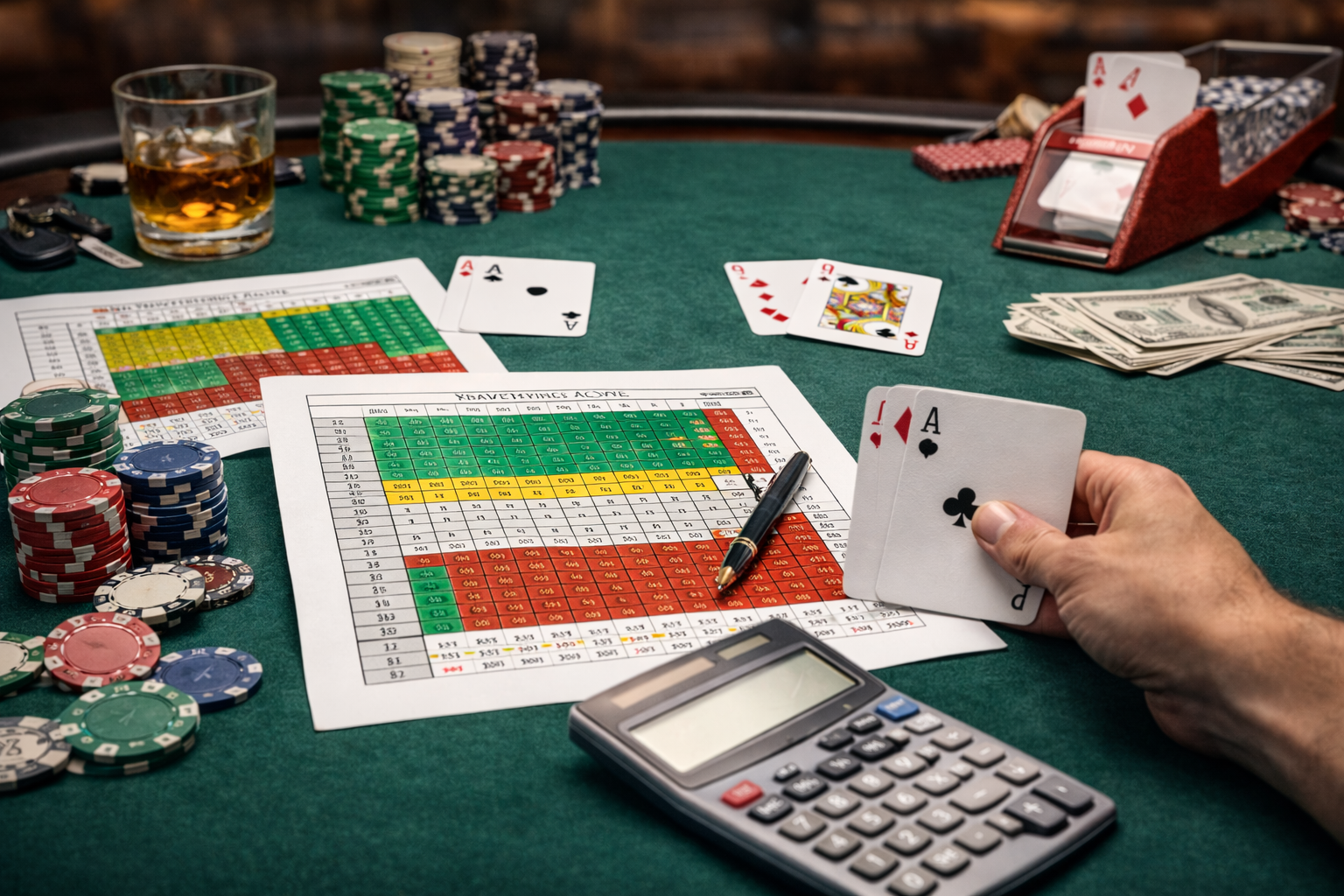
The classic basic how to play double exposure blackjack strategy chart was designed around incomplete information. It tells you what to do when you can only see one dealer card. Hand that chart to someone at a double exposure table and they'll be making wrong decisions on nearly every difficult hand. Strategy adjustments here are not minor tweaks — they're total rewrites. For example, you'll hit 17 against a dealer 18. You'll stand on hands you'd normally double. The entire decision tree is rebuilt from the ground up.
Full information sounds like it eliminates the house edge, but casinos are not running a charity. The rules surrounding this format are specifically designed to claw back the player's informational advantage. Understanding these rules before you sit down is not optional.
The most visible double exposure blackjack cost of transparency is the payout 1:1 rule on natural blackjacks. In standard blackjack, hitting a natural pays 3:2 — a $100 bet returns $150. Here, that same blackjack pays even money, giving you $100. Over hundreds of hands, that difference is enormous. The house recovers a significant portion of its lost edge just from this single rule change.
If you've played any casino card game, you know that ties usually result in a push — you get your bet back. Not here. Dealer wins ties on every hand except a natural blackjack from both sides. That means if you both land on 18, the dealer takes your chips. This is the single most punishing rule in the format and the primary reason the house edge remains meaningful despite full card visibility.
Rule variations in this format typically restrict re-splitting of pairs and limit doubling down to specific hard totals (often 9, 10, or 11 only). Player constraints like these remove options that skilled players would otherwise use to reduce the house edge further. When you can't re-split aces or double after a split, you lose equity that basic strategy would normally recover.
Playing smart at a double exposure table means abandoning instinct and trusting math. Here are the practical shifts that matter most when you play double exposure blackjack online or at a live table.
If the dealer shows 19 and you're sitting on 17, standing is just a polite way of losing. The math demands you hit, even with a high risk of busting. This is where advantage play thinking kicks in: you're not playing to avoid busting, you're playing to beat a known total. Some players struggle emotionally with hitting 18 or 19, but when the dealer's hand is visible and higher, there's no rational alternative.
💡Build a separate reference card specifically for this format. Mark every dealer total from 17–20 and what your minimum hitting threshold should be. Don't rely on muscle memory from standard blackjack.
Spotting a dealer bust hand is one of the few genuinely comfortable moments at this table. If the dealer is showing a hard 16 with no way to improve without drawing, and you're holding a pat hand, stand. Don't overthink it. The dealer must follow fixed drawing rules, and if their hand is already weak, adding more cards only helps you — as long as you don't bust first.
Every push that becomes a double exposure blackjack dealer win adds hidden cost to your session. Standard blackjack house edge sits around 0.5% with perfect basic strategy. In double exposure formats, the house edge typically climbs to between 0.5% and 1% depending on the specific ruleset — and that's with optimal play. For most recreational players who aren't using a tailored strategy, the real edge faced is higher. Knowing this shapes bankroll decisions as much as hand decisions.
|
Feature |
🃏 Classic blackjack |
👁️ Double exposure |
|
Dealer cards shown |
🔴 One face-up |
✅ Both face-up |
|
Blackjack payout |
💰 3:2 or 6:5 |
⚠️ 1:1 even money |
|
Ties (pushes) |
🔄 Bet returned |
❌ Dealer wins |
|
Splitting rules |
✅ Usually flexible |
🔒 Often restricted |
|
Strategy chart |
✅ Standard applies |
❌ Custom required |
|
House edge (optimal play) |
~0.5% |
~0.5–1% |
|
Beginner transparency |
❌ Low |
✅ High |
This format suits specific types of players more than others. If you're deciding whether to try real money double exposure blackjack, the answer depends on your playing style and your tolerance for variance.
New players often freeze at the table because they can't figure out what the dealer might have. Removing that unknown lowers cognitive load significantly. You see everything, you process the decision more cleanly, and you build pattern recognition faster. That said, beginners still need to learn the adjusted strategy — seeing both cards doesn't tell you what to do with them.
Because every tied hand is a loss rather than a neutral event, your bankroll swings harder in this format. You might play a technically solid online double exposure blackjack session and still end down because of six or seven lost pushes in an hour. Bankroll management here means accounting for that extra variance — at minimum, bring 20–25% more than you'd usually set aside for a standard blackjack session.
💡Set a session stop-loss before you sit down. Because the swings feel counterintuitive (you're playing well but still losing ties), it's easy to chase losses in a way you wouldn't at a standard table.