









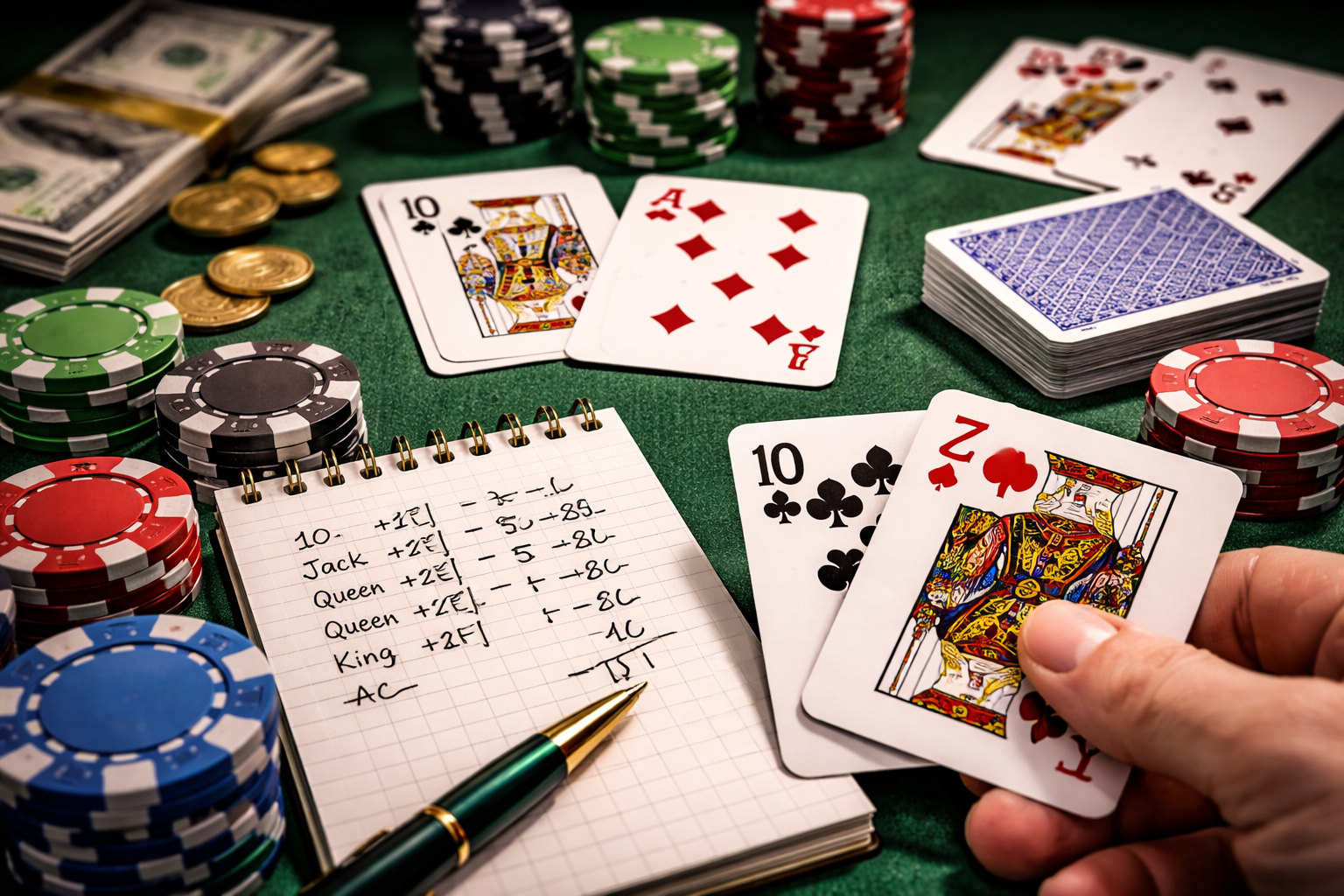










A blackjack strategy card is the most effective tool a player can use before touching a single chip. This guide treats basic strategy as a strict mathematical model — not a collection of tips — built from millions of computer-simulated hands. Every recommendation here is rooted in probability, not instinct. Apply it consistently and the house edge at Shazam Casino drops to just 0.5%.
Probability drives every decision in blackjack basic strategy chart turns that probability into a repeatable system. Computer simulations mapped the optimal action for every possible hand combination, removing guesswork entirely. The result is a decision framework that performs better than any intuition-based approach over time.
Short blackjack strategy card sessions belong to luck — long sessions belong to math. Players who follow a blackjack strategy basic chart consistently outperform those playing by feel, because every deviation from optimal play quietly shifts the edge back to the house.
Random play costs a player roughly $450 per 1,000 hands at $10 stakes. Basic strategy cuts that to around $50. That gap is the mathematical edge of discipline over impulse.
|
🃏 Playing style |
🏠 House edge |
📊 RTP |
💸 Expected loss (1,000 × $10) |
|
🎲 Random play |
~4–5% |
~95% |
~$450 |
|
🤔 Intuitive play |
~2–3% |
~97% |
~$250 |
|
✅ Basic strategy |
~0.5% |
~99.5% |
~$50 |
|
🧠 Basic + card counting basics |
~0.1–0.3% |
~99.9% |
~$15 |
Human brains are wired to find patterns in chaos — a serious liability at the blackjack table. Standing on 14 against a dealer 7 because it "feels right" hands the casino a significant advantage. The chart blackjack replaces those flawed instincts with verified, calculable math.
A blackjack table chart is a two-axis grid: your hand on the Y-axis, the dealer's upcard on the X-axis. The intersecting cell shows the statistically correct move. Fluent chart reading under real-game speed takes focused practice — not just a glance.
Your total runs down the rows; the dealer's upcard runs across the columns. Hard totals, soft totals, and pairs each occupy a separate grid — using the wrong one produces incorrect decisions.
The basic blackjack strategy chart uses four core symbols: H = hit, S = stand, D = doubling down, SP = splitting pairs. Some versions add R for the surrender option. Learn the legend first — the rest follows naturally.
Hard hands contain no flexible Ace; soft hands do. Because soft hands can't bust on the first draw, they follow more aggressive doubling rules — which is why the black jack chart keeps them in a separate grid entirely.
|
🃏 Your hand |
🔵 Dealer 2–6 |
🔴 Dealer 7–Ace |
✅ Action |
|
⬇️ 8 or less |
H |
H |
🎯 Always hit |
|
9️⃣ 9 |
D |
H |
💥 Double vs. 3–6 |
|
🔟 10–11 |
D |
D/H |
💥 Double most cases |
|
1️⃣2️⃣ 12 |
S |
H |
🛑 Stand vs. 4–6 |
|
⚠️ 13–16 |
S |
H |
🛑 Stand vs. bust cards |
|
🏆 17+ |
S |
S |
✅ Always stand |
Hard hands make up the majority of decisions at the table, and the basic strategy blackjack chart handles each one with a clear rule. The core logic: let a vulnerable dealer (2–6) bust, and draw aggressively against a strong dealer (7–Ace). The hit vs stand decision is always math-based, never fear-based.
Dealers showing 2–6 must draw to 17 and carry a high bust probability. Standing on 12–16 in these spots means leveraging that statistical vulnerability — drawing only adds risk to a hand that can win without improvement.
A hard 8 or lower cannot bust on one draw, so there's no logical reason to stand. Every blackjack play chart recommends hitting without exception, since landing a 10-value card builds a strong total with zero downside on the first hit.
Hard 16 against a dealer 10 produces a loss more than 75% of the time no matter what you do. Hitting — or surrendering when available — gives a better expected value than standing, which is what separates disciplined players from emotional ones.
Soft hands offer a built-in safety net — if the Ace must flip from 11 to 1 after a draw, there's no bust. That flexibility enables a far more aggressive strategy, especially against dealer weak cards.
Soft 13–18 are prime doubling opportunities when the dealer shows 4, 5, or 6. The basic strategy chart calls for doubling here because you combine the dealer's bust probability with your own inability to bust on one card. Soft 17 (A+6) should always be doubled against dealer 3–6 — standing is a mistake.
Soft 19 and 20 are strong enough that drawing rarely improves the expected outcome. Stand on both in nearly every scenario — the only notable exception is Soft 18 against a dealer Ace, where hitting is correct.
When a hit forces the Ace to count as 1, the hand converts to a hard total. Switch to the hard total grid immediately — many players miss this shift and apply the wrong chart for the rest of the hand.
|
🃏 Hand |
🎴 Dealer card |
🎯 Move |
📐 Reason |
|
A,2–A,3 |
5️⃣–6️⃣ |
💥 Double |
Dealer bust + Ace flex |
|
A,4–A,5 |
4️⃣–6️⃣ |
💥 Double |
Drawing upside + bust zone |
|
A,6 |
3️⃣–6️⃣ |
💥 Double |
Never stand here |
|
A,7 |
2️⃣–6️⃣ |
💥 Double |
Strong base + weak dealer |
|
A,7 |
7️⃣–8️⃣ |
🛑 Stand |
18 holds well |
|
A,8–A,9 |
🃏 Any |
🛑 Stand |
19–20 needs no help |
Splitting pairs correctly turns one losing hand into two winning positions — done wrong, it doubles the damage. The blackjack chart basic strategy gives a fixed rule for every pair combination.
Two Aces become two hands starting at 11 — one of the best starting positions in the game. Two 8s form a hard 16 — the worst hand in blackjack — and splitting escapes it entirely. No exceptions under any multi-deck strategy rule set.
A pair of 10s is a 20; breaking it is indefensible. A pair of 5s is a 10, which is ideal for doubling — not splitting. Both moves destroy strong positions for no strategic gain.
These mid-range pairs gain value from splitting only when the dealer is exposed at 2–7. Against a stronger upcard, hitting preserves a better expected outcome than splitting into two mediocre starting hands.
|
🃏 Pair |
🔵 vs. 2–6 |
🔴 vs. 7–A |
💡 Logic |
|
🅰️ A–A |
✅ Split |
✅ Split |
Two hands at 11 |
|
8️⃣–8️⃣ |
✅ Split |
✅ Split |
Escape hard 16 |
|
🔟–🔟 |
❌ Never |
❌ Never |
Don't break 20 |
|
5️⃣–5️⃣ |
❌ Never |
❌ Never |
Double instead |
|
2️⃣–2️⃣, 3️⃣–3️⃣ |
✅ Split |
❌ Hit |
Bust zone only |
|
6️⃣–6️⃣ |
✅ Split |
❌ Hit |
Weak pair logic |
These two options sit at opposite ends of the value spectrum — one saves money, the other consistently drains it.
The surrender option recovers half your wager on unwinnable hands. Hard 15 vs. dealer 10 and hard 16 vs. dealer 9–Ace are textbook surrender spots in any multi-deck strategy. It's not weakness — it's the mathematically optimal exit.
Insurance pays 2:1 but requires roughly a 1-in-3 dealer blackjack probability to break even. The actual odds sit near 1-in-4.5. Every insurance bet bleeds money over time — skip it without exception.
Single-deck blackjack carries slightly different optimal plays than six- or eight-deck games. Most tables at Shazam Casino use 6–8 decks, so always verify your chart matches the deck count. Small differences — like soft 18 doubling rules — change between formats.
Online play offers one massive structural advantage: no one stops you from referencing a chart on every single hand.
Shazam Casino places no restrictions on chart use during online sessions. Keep a printed sheet nearby or open the strategy basic chart in a second tab during live dealer games — every decision becomes optimal by default.
Real-money tables run faster than practice modes. Train until chart lookup takes under 3 seconds per decision. Begin at $1–$5 stakes until both speed and accuracy are consistently reliable.
Free-play blackjack at Shazam Casino is purpose-built for chart drilling. Run 200–300 hands with the chart visible, verify every decision in real time, and build the muscle memory that turns strategy into reflex.